


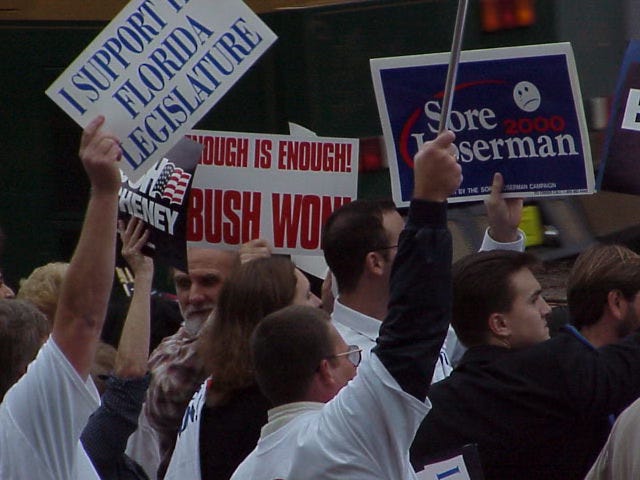
It was 26 years ago, in November 2000, when Americans learned more about the mechanics behind the voting process than they probably cared to know. The election for President of the United States came down to fewer than 1,000 votes in Florida, and determining who won was not straightforward. A recount was conducted in several counties, and there were not clear rules for how to count ballots that had unclear markings.
One thing that was made perfectly clear, however: Americans from both parties realized that our elections processes had been neglected. The Florida fiasco made it evident that there was a need to update them. By the year 2000, most election jurisdictions were using infrastructure that was becoming rapidly outdated, such as the punch cards in Florida or lever machines in wide use elsewhere, and standards for maintaining voter rolls and auditing election results were lacking.
In 2002, the Congress and President George W. Bush worked together to develop the Help America Vote Act (HAVA), a law that was intended to address many of these problems. And it succeeded. Because of HAVA, elections in the United States have improved dramatically over the past quarter-century. Having worked on the professional staff of the National Commission on Federal Election Reform, whose recommendations helped shape HAVA, I am very proud of how far our elections have come.
Today, when the legitimacy of the election system itself is being debated more than any time in recent memory, curious Americans of any type, from voters, to advocates, to politicians, should include the progress made under HAVA in their thinking. Two areas of improvements under the law have made the electoral process particularly more secure and more accurate: voter registration and post-election vote tallying.
Voter Registration
For all the angst today about voter list maintenance procedures state to state, consider this: Only 11 states had voter registration databases that covered every local election office in their state in 2001, per a report from the National Commission released that year. In the remaining 39 states, voter registration databases were held in each local election office, and there was no centralized mechanism for ensuring that voters were not registered to vote in multiple counties in the same state. There was also not a process for validating a voter’s information against either the state’s motor vehicle database, or against the Social Security Administration’s database. This lack of tools made the work of maintaining accurate voter rolls a more disorganized process than it needed to be, when technology was becoming available to make the process easier.
Thanks to HAVA, every state now has a central voter registration database, which helps to eliminate any duplicate registrations in-state. In addition, every person who registers to vote is verified against either the state’s driver’s license records or the Social Security Administration’s Help America Voter Verification system. If a person does not provide proper identification when they register to vote, they are required by federal law to show identification the first time they actually vote.
With a statewide system, conducting uniform list maintenance is much easier. States can search for duplicate registrations across the state — for example, by comparing names, dates of birth, and the last four digits of a person’s social security number — and removing these individuals from the rolls. States can also match their databases against the US Postal Service National Change of Address data to identify individuals who may have moved out of state. Once these matches are identified, local election officials can begin the process of removing voters from the election rolls, using the process outlined in a separate federal law, the National Voter Registration Act.
In addition, the Electronic Registration Information Center (ERIC), a consortium of 25 states and the District of Columbia, was created in 2012, to help states match voters who may have moved across states and begin the process of removing duplicate registrations. ERIC was made possible because of the upgrades to state election data spurred on by HAVA. The U.S. went from having dozens or hundreds of municipal or county-level voter registration databases in each state, to having just 50 statewide databases nationwide. These HAVA-mandated statewide databases created the framework that allowed for state data-sharing though systems like ERIC.
ERIC has also been used to identify individuals who have voted in more than one state in the same election, facilitating election-fraud prosecutions, such as a recent one in Pennsylvania. Although the 15-year-old program has faced calls for reform, which are beyond the scope of this piece, the bottom line remains that participating states’ election rolls are cleaner with ERIC than without it.
Post-Election Processes
One of the fundamental issues in the 2000 Presidential Election was how to handle counting and recounting the ballots and how to ensure that the results were accurate. In Florida, there was not uniform guidance for how to review ballots and how to resolve discrepancies in vote totals. Different counties in the State used different standards to determine whether a person had or had not voted for a specific candidate. This variation in standards is, in part, what ultimately led the United States Supreme Court to rule to end the recount process in the case Bush v. Gore.
After the enactment of HAVA, all states were required to adopt uniform standards for how to adjudicate ballots where there was a question of voter intent. States developed manuals showing how various types of marks were to be tallied (or considered a non-vote, depending), so that today, in a recount, there is a uniform reference for reviewing questionable ballots. This uniformity means that everyone — candidates, political parties, and the public — are all made aware of how ballots in a post-election challenge will be reviewed.
In addition to the uniformity in reviewing ballots in a recount, there are also now more post-election audits of election results than there ever have been before. In 40 states and the District of Columbia, audits are conducted after every election to verify that the results are accurate, and the public can be confident in the election outcome. In 31 states, the audit must be completed before the election can be certified, and 9 states conduct their audit after the election has concluded. In almost all cases, these audits involve reviewing a sample of paper ballots to ensure that a hand count of the ballots matches up to the electronic results. These partial recounts often involve individuals representing both political parties coming together to count the ballots and verify that the totals match those in the local election management system.
A Bright Election Future
As readers of this piece have probably already realized, elections are a technical and multilayered process to administer. It’s understandable, then, to have questions about the ins and outs of it. As a longtime election researcher, and a current election administrator, I enjoy the opportunities to provide some answers. In this case, more Americans should know just how far the system has come in the last 25 years. If you told me then what our elections would look like today, I would have been skeptical.
It is true that we need to keep improving our elections and making voting more secure and more accessible, with more public audits that allow everyone to be confident in the results, whether their favorite candidate wins or loses. However, we are building on a strong foundation, much stronger than many people might appreciate.
Thad Hall is the Director, Mercer County (Pa.) Voter Registration and Election Bureau. He has held similar positions in Arizona and South Carolina, and was a member of the professional staff of the National Commission on Federal Election Reform.

Agreed, we have come a long way, Baby... but.
Just as computer network attacks can trigger improvements in database management, the outside criticism can also impel badly needed reforms. And nothing demands more development than both the audit process and EMS certifications. Until election officials quit defending the processes against outside critique, and sit down with the less-credentialed late comers to the game, we'll never see widespread trust in our electoral process. So, let's quit the congratulatory messaging and start listening to some of the newer voices to the conversation. Many of the ones with whom I work, have brought tremendous "surplus intellectual capital" to the election integrity movement. They often have impressive resumes in industry and government, but none of it is election-related. When Ray Kroc was growing McDonalds, he made it a point to invite franchisees from outside industries. This benefitted his firm by injecting new ideas and processes that gave them a competitive advantage. To wit... EVERY state Chief Elections Official would do well to scour the land for such experts in their state and invite them for coffee!